OPINION ARTICLE
You've been told Artificial General Intelligence (AGI) is arriving and that AI will rewrite your industry. Yet leading technology companies - META, Google, Anthropic – are using the world’s data largely for free. According to MIT, 95% of companies investing in it see no measurable return. According to Alexander Girardet, an engineering specialist with the London-based Alavida who often writes on AI, you'll understand AI transformation by the end of this article better than most trying to sell it to you. It starts with Henry Ford.
Lesson 1: AI only pays off when you rebuild your firm around it
In the early 1900s, Henry Ford lived through a revolution much like ours. The new technology was electricity, and everyone agreed it would change how work got done.
To see why, you need to know how a factory ran before it. A single steam engine burned coal all day. It turned one long shaft along the ceiling, and from that shaft a leather belt dropped down to drive every machine on the floor.

Henry Ford
The system was ingenious, but it came with three constraints:
- Machines had to sit where the power was. Everything lined up under the shaft, wherever the work actually needed to happen.
- The shaft could only run so far. The longer it got, the harder it was to carry power down the line, so factories were stacked over several floors. That made them expensive to build and expensive to run.
- Nothing could run on its own. If the engine stopped, the whole floor stopped, and you couldn't switch off one machine without stopping the rest.
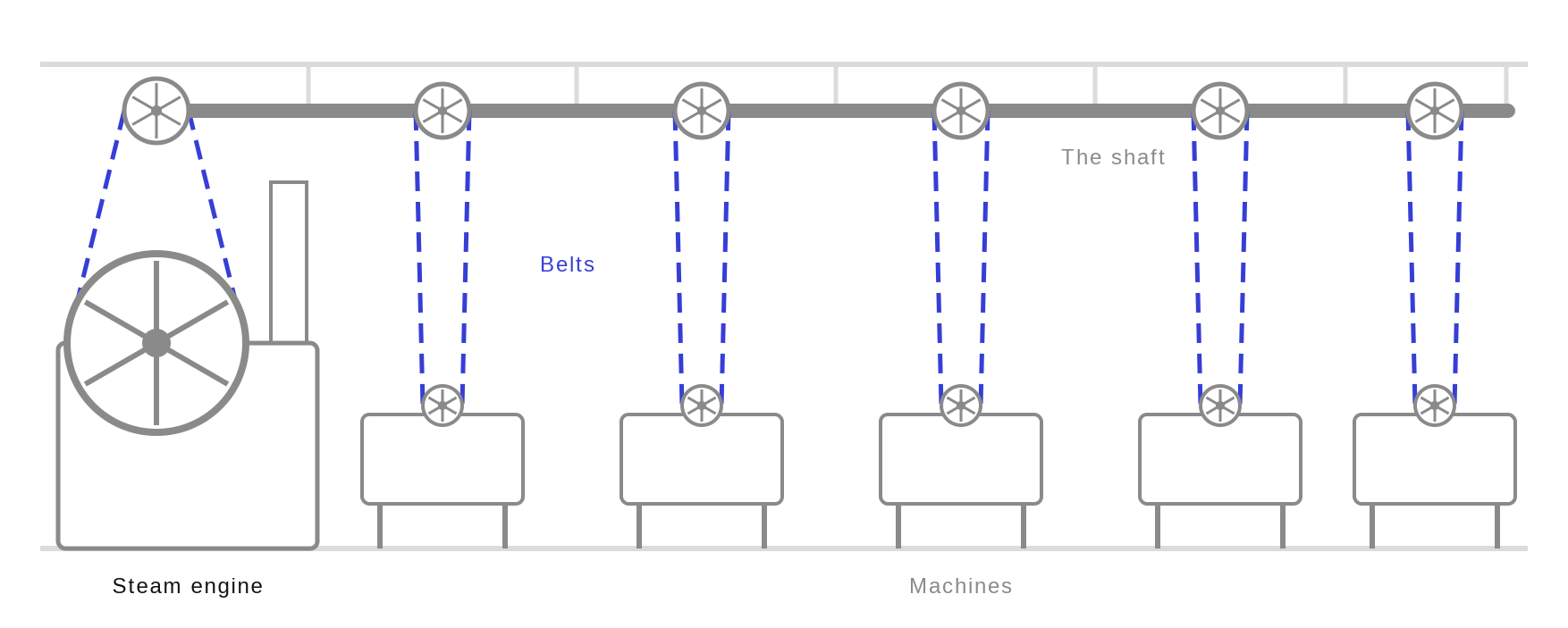
Steam Engine with factory belts
The engine decided the layout of the factory, and the work had to fit around it.
Electricity promised to change that. Every machine could have its own motor. You could put a machine wherever the work needed it, switch one off without stopping the others, and rearrange the floor whenever you found a better way to work.
By 1919, more than half the power in American factories was electric, yet productivity had barely moved. It took around thirty years for the gains to arrive.
The reason was simple. Most owners pulled out the steam engine, put an electric motor in its place, and kept the same shaft, belts and machines. They bought the new power and kept the old factory.
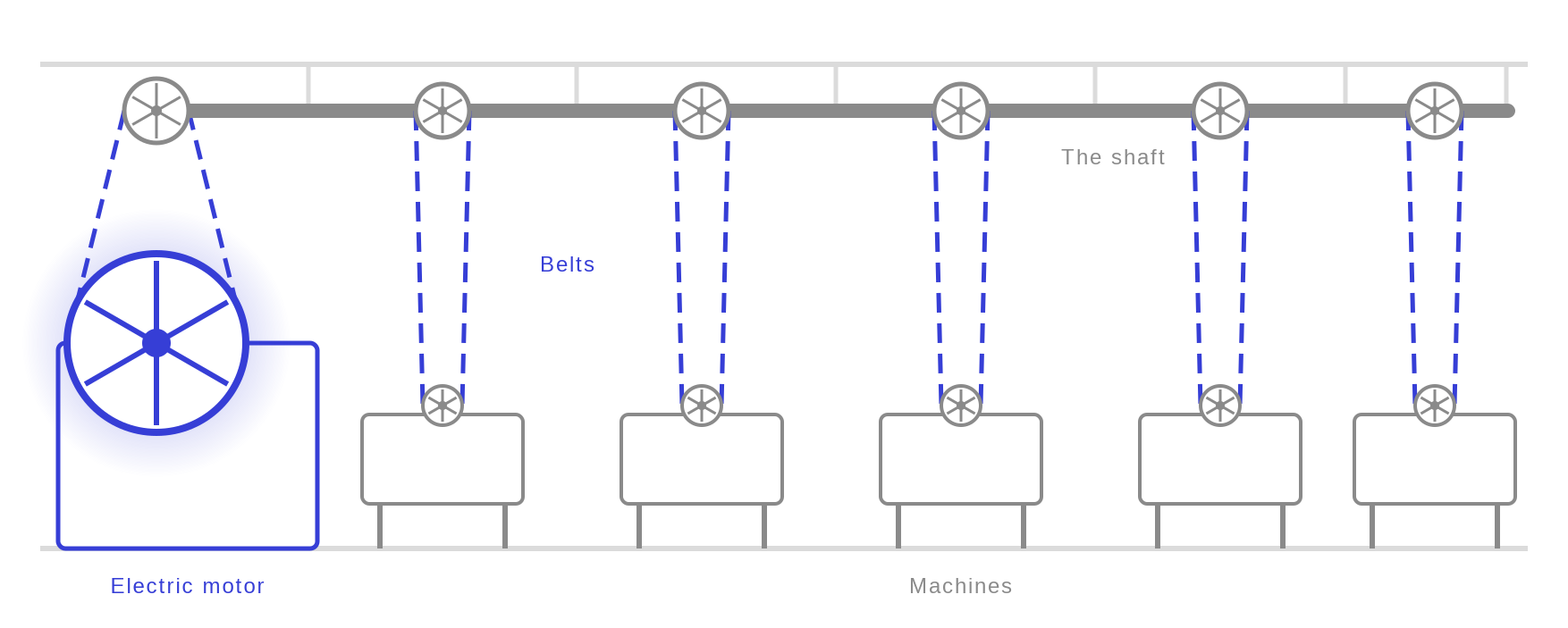
The electric swap
Ford rebuilt instead. He designed his factory around one principle: power and light everywhere on the floor. With no shaft to line up under, he could place machines in the order the work happened, and that gave him the moving assembly line. Building a Model T fell from 12.5 hours to 93 minutes. The price dropped from $850 to $260, and by the early 1920s Ford dominated the market.
That's the first lesson: AI only pays off when you rebuild your firm around it.
Now look at how most firms use AI today:
- Everyone gets a ChatGPT licence.
- Copilot drafts the emails a little faster.
- AI summarises the quarterly report someone spent two weeks pulling together by hand.
That's swapping the engine. You've changed who does the thinking, yet the work still flows exactly as it did before.
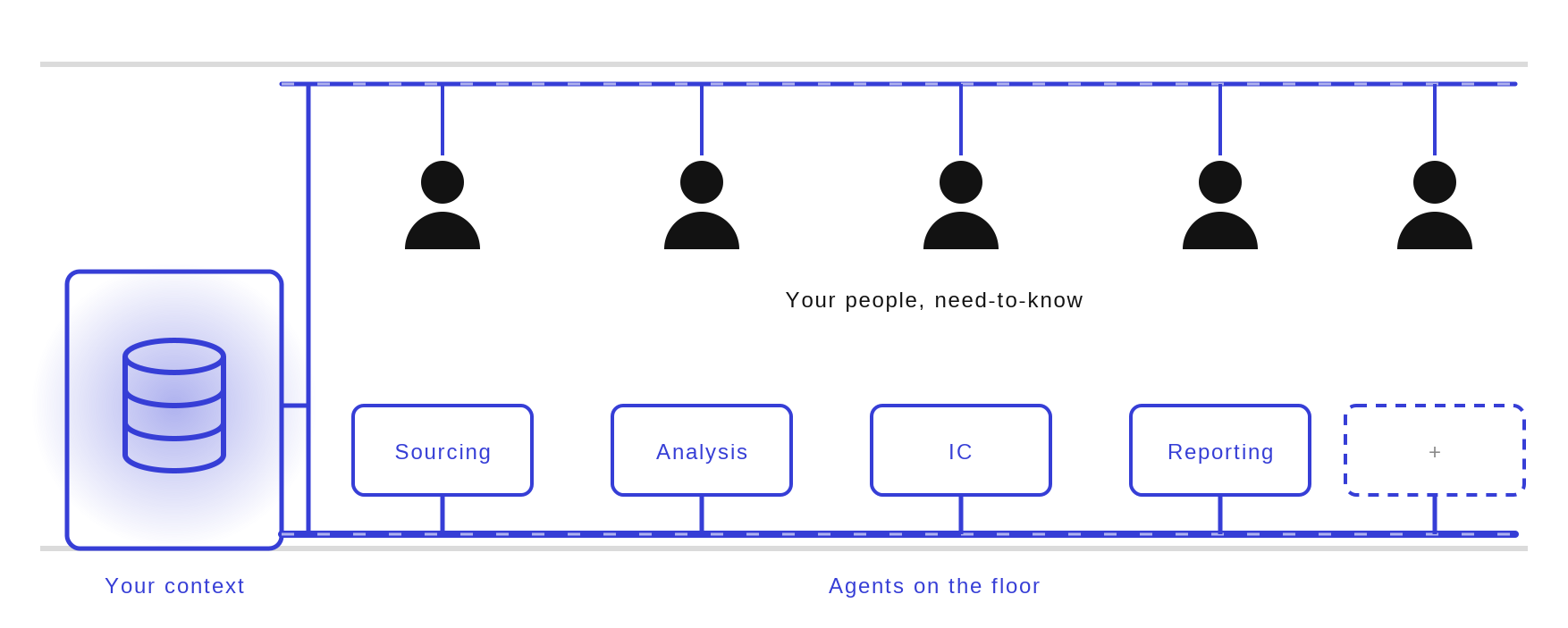
The Family Office
Lesson 2: Get the right information to any AI, at the right time
Most firms measure their progress with AI by how powerful the model is. A new one launches every few weeks (53 frontier models so far this year, by one count), and the conversation moves to the latest. It's the wrong thing to measure.
These models are extraordinary, and they know the world's information. The information that runs your firm lives inside your walls: your deal notes, your models, your conversations with GPs. Hire a genius physicist tomorrow who knows nothing about how your firm works, and they won't move the needle. A more powerful model has the same problem.
This matters more now because AI has started doing the work itself. These systems are called agents: give one a task and it works out the steps to finish it. In Ford's factory, electricity ran the machines. In yours, AI runs the agents.
The simplest way to think about an agent is as a new hire. It's brilliant, and it knows nothing about your business. On day one, you'd show a new hire where the deal notes are, which tools to use and how things are done here. An agent needs exactly the same.
Today, most of that information reaches the AI by hand. Every time you paste an email thread into ChatGPT, forward a document or drop in a deck, you're carrying it there yourself. You are the belt.
Ford built around power everywhere. The equivalent for your firm is contextification: building around one principle, getting the right information to any AI, at the right time.
Here's what that factory floor looks like: your information on one side, wired to your people along the ceiling and to agents working on the floor.
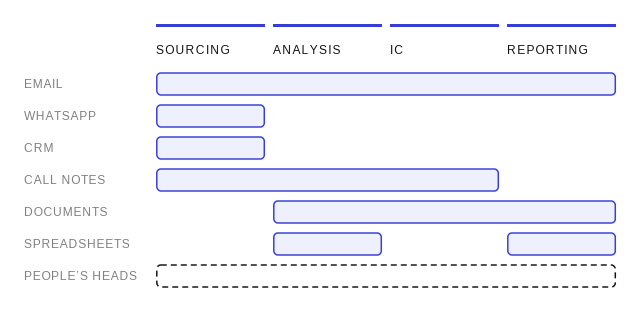
Where information lives...
What that looks like in a family office
A deal moves through four stages:
- Sourcing: finding and filtering deals
- Analysis: diligence and modelling
- IC: the investment decision
- Reporting: tracking the portfolio
The information each stage needs is spread across tools you already use, and no single tool covers a whole stage.
You don't need to move any of it. A context engine connects these tools through a single gateway, and gives every agent a map of what lives where, who owns it and what's private. Each agent, and each person, sees only what they're allowed to.
What's a gateway?
MCP (Model Context Protocol) is an open standard for connecting AI to your tools and data. A gateway is a single door between your systems and any AI model, and you control it. You connect each tool once, decide who and what can see it, and keep a record of everything an agent touches. When you switch models, the connections stay.
Where to start
With our clients, we start with sourcing, because that's where information gets lost first. The first job is making it effortless to capture. We put an agent in WhatsApp, where deal conversations already happen. Send it a voice note after meeting a GP, and it logs the deal in the CRM, runs a first pass against your own checklist, and then flags what's missing and emails your team.
The agent handles the first pass: the data cuts, the basic checks, keeping the team updated. Your people spend their time on the judgement calls.
Lesson 3: Own your context and rent the models
Once your information flows to your AI, there are three risks to keep in mind.
The risk is conformity
A family office is paid to make better decisions than everyone else and to find the deals others miss. If every firm asks the same models the same questions using the same public information, they'll reach the same answers.
Ford ran into a version of this. He locked his factory around one car in one colour, and when buyers started wanting choice, General Motors overtook him. Your edge is what the model doesn't have: your relationships, your deal flow, your track record and your people's judgement. Build around those, and let any model plug into them.
The risk is vendor lock-in
Picture a factory that only runs on one energy supplier. If they raise their prices, you pay. If they go down for a day, your whole floor stops.
Most firms are building AI exactly this way, with every agent and all their information wired into one provider. Keep your information in your own systems and connect models through your gateway, so you can switch when a better or cheaper one arrives. We run several models side by side for this reason. Treat the model like any other supplier you could replace.
The risk is giving AI too much access
You'd never give a new hire the keys to every room on their first day.
This summer, one of us connected a powerful model to all of his accounts. It misread a situation and emailed the wrong person to ask her on a date. That was embarrassing, and harmless. The same mistake with a wire transfer wouldn't be. Give each agent only the access its job needs, and keep a person approving anything that can't be undone.
What to take back to your firm
- AI only pays off when you rebuild your firm around it.
- Build around one principle: the right information, to any AI, at the right time.
- Own your context and rent the models.
The models will keep improving, and you can swap them in as they do. Your relationships, deal flow and judgement are the one thing a competitor can't buy.
London-based Alexander Girardet is a Swiss-American AI Architect and co-founder of Alavida, which helps build data and AI systems at scale for both large enterprises and early-stage startups. For more information on developing context engines, please contact: https://alavida.ai/


