William Thatcher Dowell·

This article by Global Geneva's America's editor was first published as part of William Dowell's Substack column A Different Place.
What are the chances that Donald Trump will simply declare victory and forget about the war he created in Iran?
No one doubts that Trump and his machismo-driven “Secretary of War” Pete Hegseth have put on a remarkable display of shock-and-awe destruction in Iran, but what has it really accomplished?
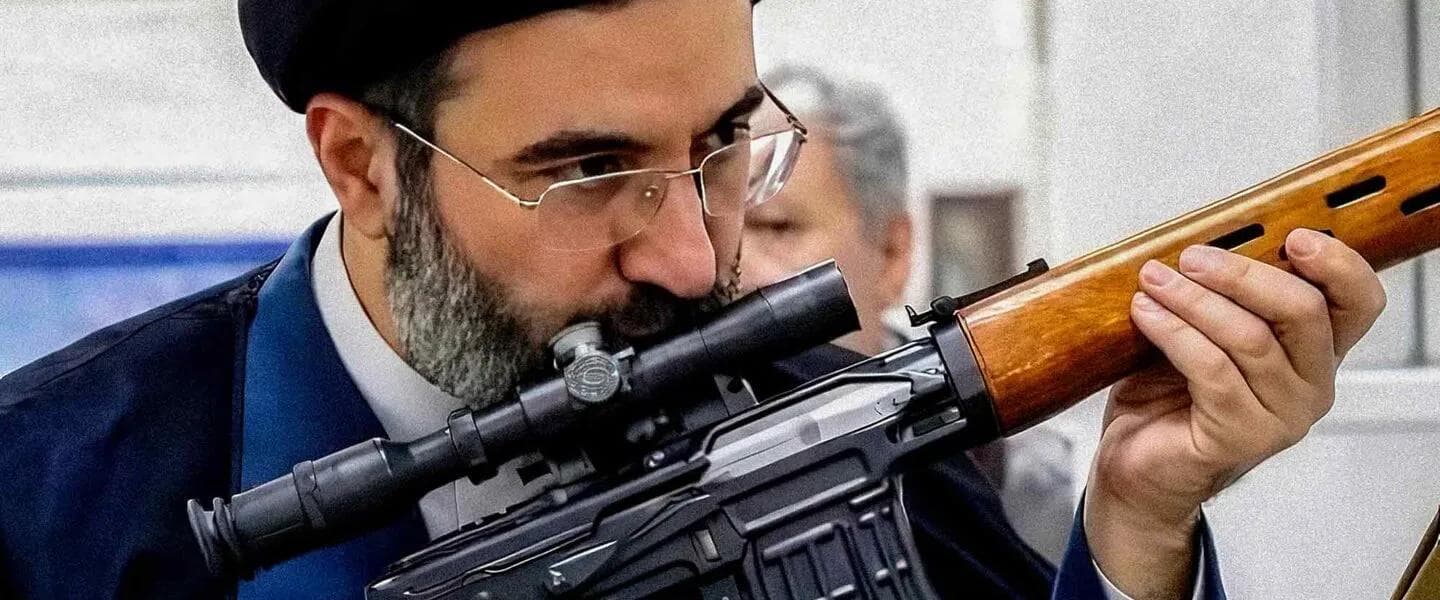
American and Israeli missiles vaporized Iran’s 86-year-old Supreme Leader Ali Khamenei, along with much of Iran’s top leadership, but Khamenei was due to retire anyway. He has now been replaced by his second son, Mojtaba Khamanei, who is rumored to be just as fanatical as his father.
Mojtaba is only 56, so he can expect to be around for many years. Like his father, Mojtaba was a mid-level cleric before being named ayatollah; he also served as an officer in the Islamic Revolutionary Guard Corps (IRGC), which his father helped create and which ultimately became one of the main sources of his support. The IRGC is one of the main reasons Ali Khamenei was able to maintain a steel grip on power for 37 years — longer than practically any other leader in the Middle East.
After the American-Israeli onslaught, the IRGC clearly sees Mojtaba as the necessary theocratic frontman it needs if it wants to continue exercising control over the country. Mojtaba’s advantage is that he is a fresh face. It was his father, not Mojtaba, who was responsible for shooting thousands of protesters. Fanatic though he reportedly is, Mojtaba may begin with something approaching a clean slate.
If Iran was not serious about building a nuclear bomb before the current attacks, it very likely is now. What Trump apparently missed in his assessment of last June’s attacks against Iran’s nuclear centrifuges is that Iran had already enriched enough nuclear material to build anywhere from six to nine bombs. Although the centrifuges were destroyed, the nuclear material was moved to another location.
Nate Swanson, a key figure in helping formulate American policy towards Iran, told the BBC that Iran could probably finish the enrichment of that material in an accelerated time period that might range from a few days to a few weeks. Swanson also felt that Khamenei expected another American-Israeli attack and was convinced that Iran should not accept yet another ceasefire unless the U.S. and Israel could guarantee that they would not attack Iran again in the future.
Even if Mojtaba were not, a priori, a fanatical hard-liner, Trump’s Israeli-inspired joint bombing campaign is believed to have killed the new leader’s mother, wife, and son, along with his father. It’s not hard to guess his future attitude towards both the United States and Israel.
If Iran was not serious about building a nuclear bomb before the current attacks, it very likely is now. Trump and Netanyahu have given Iran every incentive to obtain whatever weapons it needs, and it looks increasingly as though Russia’s Vladimir Putin is willing to help. China may step in as well.
If Trump hasn’t realized it yet, taking on Iran is promising to be a lot more formidable and involves considerably more unpredictable unknowns than kidnapping an unpopular president of Venezuela. It’s not hard to see why Trump may be tempted to declare victory and forget about the mess that he has created.
He may not have that option.
Somewhat ominously, Iran’s Minister of Foreign Affairs Abbas Araghchi told NBC News’s Meet the Press over the weekend that Iran doesn’t want a ceasefire, at least not at this point. “There needs to be a permanent end to the war,” Araghchi said. “Unless we get to that, I think we need to continue fighting for the sake of our people and our security.”
Araghchi didn’t deny reports that Russia has been providing Iran with intelligence about US and Israeli movements. Equally ominous, observers have pointed out that although Iran has been firing missiles at a number of countries in the region, it also appears to be holding back on the number that it fires, which may be an indication that it is settling in for the long haul. Meanwhile, the US has been reduced to asking Ukraine for assistance in fending off Iran’s Shahed drones.
The Iranians may not have the equipment needed to produce an American-Israeli-style demonstration of shock and awe, but they have one simple advantage that may prove critical — the Strait of Hormuz.
The strait is roughly 20 to 30 miles wide at its narrowest point. The northern coast of the strait belongs to Iran; the southern coast to Oman. Any ship exiting the Persian Gulf has to follow Iran’s coast and then make a 90-degree turn and continue following Iran’s coast into the Arabian Sea. Of the eight islands in the strait, Iran owns seven, and it has maintained a military presence on most.
The strait is an extremely vulnerable bottleneck, and a fifth of the world’s oil supply and a quarter of its natural gas must run a gauntlet that Iran has now vowed to keep closed. Trump has suggested that US Navy ships might be used to escort tankers through the strait but, with Iran’s access to increasingly sophisticated missiles, that might risk losing a Navy ship as well as a tanker.
In any case, no insurance company has been willing to take the risk, and it’s been estimated that around 300 ships are currently bottled up in the Persian Gulf. Making the area safe for shipping would very likely require sending in American troops on the ground in one of the more inhospitable places on the planet.
For the moment, there is enough oil outside the Gulf for most countries to continue functioning, but if the strait remains closed for long, it could trigger a world financial crisis. That’s what happened during the Arab-Israeli war in 1973, when OPEC (Organization of Petroleum Exporting Countries) clamped an embargo against the US and other countries for supporting Israel.
The price of a barrel of oil quadrupled in the US, and that led to inflationary price increases on just about everything. More than fuel costs were affected: Products made from petroleum byproducts — such as fertilizer, plastics, even the glue used to make plywood — suddenly became unobtainable.
Richard Nixon, who was president at the time, imposed a 55-mile-per-hour speed limit on highways in a desperate attempt to limit fuel consumption. Nixon was eventually forced to make a number of costly concessions to Middle Eastern oil producers, and the embargo was lifted in 1974.
Most Americans living today either weren’t born in 1973 or, like Trump and Hegseth, may be forgetting or simply ignoring the lessons of what happened then. The Iranians, however, are acutely aware of that history, and they seem increasingly confident that, despite the 10 days of deadly US and Israeli bombardment, and Hegseth’s braggadocio, they still have options. Financial ruin for a large part of the world might be one of them.
The war with Iran could be just beginning.
Foreign correspondent and author William Dowell is Global Geneva's America’s editor based in Philadelphia. Over the past decades, he has covered much of the globe, including Iran, for TIME, ABC News and other news organizations.

Initial victory can look tantalizingly quick. It's the aftermath that gets you.
Read more →
America’s 'Secretary of War' insists that we’re no longer into nation-building; translation: Trump is spreading chaos in Iran with no an exit-plan in sight.
Read more →
Leading up to the Geneva Book Fair (18-22 March, 2026) we look at the state of reading and bookselling.
Read more →