Trump’s Flirtation with War Against Iran
Iran might look like an easy target. It's not. Remove one problem and you risk facing another that could be far more serious.
William Thatcher Dowell·

Iran might look like an easy target. It's not. Remove one problem and you risk facing another that could be far more serious.
Cartoons with kind courtesy of contributing Global Geneva editor Jeff Danziger.
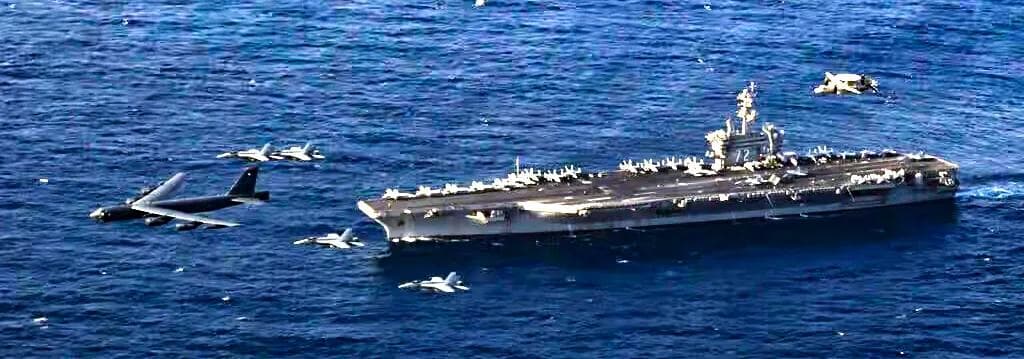
A number of Middle East experts have warned Donald Trump that a new military attack against Iran might trigger a much larger conflagration that risks enveloping the entire region. Trump has continued a military buildup anyway, and is talking about sending yet another aircraft carrier into the region.
Despite his TACO nickname (Trump Always Chickens out), Trump’s dominant characteristic until now has been a readiness to trust his own instincts rather than rely on the experts.
Trump and the MAGA crowd are obsessed with what they see as the “Deep State,” or in simpler words, the Washington Establishment. Mostly, they are frustrated that what used to be considered the Establishment now sees them as uncouth outsiders, ignorant of history and with little understanding of international relations or diplomacy. This time around, Trump might do well to listen to the experts.
The difference between the Trump administration and what remains of the U.S. State Department is decades of experience. Despite its traditional euphemism, Foggy Bottom, the State Department is all too aware of what can happen when an administration in Washington gets it wrong. A not too distant example of how things can go wrong is the case of George W. Bush’s efforts to topple Iraq’s Saddam Hussein. (See also Global Geneva article on the Trump-Biden debacle in Afghanistan)
As Bush discovered, using America’s overwhelming military superiority to defeat a weakened Iraqi regime was not difficult. The mistake that the administration’s key strategists, Donald Rumsfeld and Vice President Dick Cheney, made was to stop the State Department from drafting a plan for what was likely to happen once Saddam’s regime was gone.
Rumsfeld’s concern was that victory in Iraq would be hamstrung by bureaucratic red tape. What he failed to realize was that the procedures he distrusted had been put in place to prevent the kind of disaster that eventually consumed Iraq because of a lack of planning.
Not just Trump, but Republican administrations in general have long felt impatience at what they saw as an overly cautious approach by U.S. State Department experts and America’s professional intelligence agencies. They have always felt a temptation to shoot first, and clean up the mess later. Unfortunately, what Hollywood scriptwriters might have mythologized about the Wild West of the late 1800s rarely works in real life. In today’s world, considerably more is at stake.
As it turned out, Bush’s ‘Operation Iraqi Freedom’ triggered a war that lasted nearly eight years from 2003 to 2011, and cost the lives of more than 4,400 U.S. servicemen, along with another 37,000 wounded. The actual fighting cost somewhere between $700 billion and $800 billion . Helping American veterans recover from the war added another $2 trillion dollars to the U.S. budgetary costs.
The justification for going into the war had been a series of highly suspect reports that Saddam might be developing a weapon of mass destruction. The reports turned out to be false.
The situation in Iran appears more serious. There is no question that Iran has made progress towards producing a nuclear weapon. What is less clear is why, or what it would do with a bomb if it had one.
Both India and Pakistan developed functional nuclear weapons and then promptly forgot about them. Simply possessing the weapon seemed to be enough of a deterrent.

Recent demonstration against the Ayatollah regime.
Social media
At a World Economic Forum meeting in Davos, Switzerland, a few years after the 9/11 attacks against the World Trade Center, former U.S. president Bill Clinton acknowledged that the roots of the problem with Iran could be traced back to the 1953 coup, which deposed Iran’s democratically elected prime minister, Mohammad Mosadegh, and restored the Mohammed Pahlavi as Shah, with complete power to do with iran whatever western powers asked of him.
The coup had been instigated by British intelligence, which asked America’s CIA to help carry it out. Mossadegh’s error had been to nationalize the Anglo-Iranian oil fields and to ask the Soviet Union for support.
What no one had counted on was that over the years, the Shah would increasingly turn into a monster who imprisoned and tortured huge numbers of his own people, including a large number of protesting students, who in many cases belonged to some of the country’s elite families. That was unfortunate in itself, Clinton suggested, but what, he asked, did anyone think that Iran was really going to do with a nuclear weapon? The Iranians had to know that as soon as they did anything, they would be obliterated by a retaliatory blazing inferno. The odds were that the Iranians were bluffing.

With kind courtesy of Jeff Danziger, Global Geneva contributing editor.
The real villain in Iran was the temptation resulting from the sudden wealth produced by oil. Traditionally, politics in Iran had been influenced by three sources of power: the monarchy run by the Shah was counterbalanced by the economic strength of the Bazaaris, Iran’s dynamic merchant class rooted in Iran’s many basaars. The third pole was Iran’s Islamic clergy.
These three groups counterbalanced each other and provided a government that was more or less in tune with public opinion, which expressed itself in Iran’s parliament and elections.
The coup and oil changed all that.
With the coup, the Shah was forced to realize that he was in control because of Western military power, and that power could remove him if he failed to listen. At the same time, the enormous wealth produced by oil meant that he no longer needed to listen to the Bazaaris or the clergy. Western power and sudden wealth were all he needed.
The separation from Iran’s traditional power base led to a gradual separation from Iran’s people. When protests erupted, the Shah relied on SAVAK, his secret police, and his Imperial Guard to keep order. If things got really out of hand, he realized that the Western powers needed him, or at least the oil, as much as he needed them.
As protests grew, so did violent repression and unspeakable torture. SAVAK was everywhere and heard everything. In the end, the only place that people could speak freely was in the mosques during Friday prayer. Events paved the way for the rise of Ayatollah Khomeini.

By kind courtesy of Jeff Danziger.
In the late 1970s, I was working as a freelance reporter in Paris, France. TIME Magazine assigned me to work on a story dealing with torture as a political tool. The issue was not whether torture was right or wrong, the question was did it work. I interviewed a great number of political refugees living in Paris who had previously been tortured by various regimes in Africa and the Middle East.
One of the interesting interviews was with Sadegh Ghotbzadeh, who headed the Iranian Students’ Union in Paris. Sadegh casually mentioned that SAVAK was not only closely allied with the CIA, but had been trained by the CIA in particularly sadistic approaches to torture. I asked Sadegh how he knew it was the CIA.
“When a new, innovative form of torture suddenly appears in a dozen countries that have no connection with each other except the CIA, it’s pretty obvious,” he said. I had no way of proving whether Sadegh was right or wrong, but it didn’t really matter.
Iranians clearly believed that what he was saying was correct. Sadegh went on to become a chief advisor to Khomeini on European affairs, and after the Iranian Revolution in 1979, he became the new government’s first minister of foreign affairs. He was later executed by the government he had helped put together. It was suspected of involvement in an attempt to overthrow Khomeini. Revolutions can be dangerous for the people who help lead them.
In 1978, Khomeini moved from exile in Iraq to the Paris suburb of Neauphle-le-Château. Because I knew Sadegh, I was able to attend Friday prayers with Khomeini. I mentioned to a political officer at the U.S. embassy in Paris that a lot seemed to be going on in Neauphle-le-Château and that someone in the U.S. embassy might want to talk with some of the key players.
“We can’t,” he said. “If we were to do that, it would be seen as sending a signal that we approved.”
In January 1979, the Shah fled Iran and installed himself in Egypt. The ABC News Paris bureau began sending camera crews to Iran regularly, and the news coming back was not encouraging. Towards the middle of January, I went to Tehran as part of an ABC team to cover the increasingly violent demonstrations that would eventually result in Khomeini’s takeover.
The U.S. embassy seemed unaware, at least publicly, of what was happening. I spoke with an American political officer, who showed me a video of a demonstration. “See,” he said, “the protesters are hurling stones at the police.”
On the video, I watched an Iranian protester walk up to a police officer, rip his shirt open, and dare the policeman to shoot him at close range. As he fell to the ground, another protester took his place and did the same thing. After several instances, the police couldn’t take it anymore. They simply gave up and disappeared.
Not long after the Iranian Revolution, I signed on with TIME as a staff correspondent covering the Middle East, based in Cairo, Egypt. When Khomeini died, the magazine sent me to Tehran to see how the Islamic government was evolving without its supreme leader.

In an interview with Akbar Torkan, the government’s first defense minister. I asked about rumors that Iran might be developing a nuclear weapon. “Nuclear weapons are useless,” Torkan said. “They cost a great deal of money, and you know that no one is ever going to use them. You are simply wasting your resources. You are better off spending the money on training and equipping a functional army that can actually fight.”
I mentioned Torkan’s comment to a friend in Paris, who knew a great deal about Iran. “They’re lying,” he said. “They are spending a lot on developing a weapon.”
The friend may have been right, but simply having a weapon is not enough to be a genuine threat these days. It’s necessary to have the means to deliver it, and also to consider the consequences if one gets it wrong. As Clinton pointed out at Davos, a nuclear attack that does not succeed in completely destroying each and every one of its opposing nuclear enemies with the first strike is likely to trigger a retaliation that results in total destruction.
A more likely scenario is that, like North Korea, Pakistan, and India, Iran wants a nuclear device not only as a guarantee against foreign attack, but also because the way the world is today, you need to have a nuclear weapon in order to be taken seriously. It’s the ultimate ticket to sit at the table with the adults.
Iraq’s Saddam Hussein tried to make the world think that he had a weapon of mass destruction in order to intimidate his neighbors and to make himself appear too dangerous to attack. He was also angry that the support he had received from the U.S. and the Gulf states when Iraq was considered to be an essential feature in containing Khomeini had dried up once Khomeini was no longer considered a threat. Saddam was bluffing, and the miscalculation backfired, costing Saddam his life.
That was unfortunate for Saddam, but at the time, many Middle East experts had advised the Bush administration that Saddam was already pretty much finished, and that if left alone, his regime might have ended with considerably less collateral damage.
The egos of different administration officials pushed those calculations aside. No doubt some in Washington thought that the “shock and awe” against Iraq was just what the American public, still recovering from the shock of 9/11, really needed. Hubris can be costly, both in lives and in money.
In any case, conquering Iran would be a much more serious undertaking than subduing Iraq. Iraq has a population of 45 million. Iran’s population is 92 million, double Iraq’s. Although Iraq had caused Britain problems during colonial days, it had never really engaged in a serious Middle East conflict until the Iran-Iraq war, which ended in a stalemate. Iraq’s Army could intimidate smaller countries in the region, but it did not really amount to that much as an organized force. Iran, on the other hand, eventually proved itself not only to have an impressive military capability but also an effective strategy and an astonishing capacity to develop formidable allies including Hizbollah in Lebanon, Hamas in Gaza, and the Houthis in Yemen.
During an Israeli incursion into Lebanon in 2006, Israeli troops were surprised to discover that the Hizbollah troops had become much more formidable than in the past. They had received professional training from Iran. Faced with unexpectedly high losses, the Israelis pulled out of Lebanon.
When Saddam mounted his invasion of Kuwait in August 1990, I was in Saudi Arabia. The concern was that Saddam’s military force would simply knife through Kuwait and grab the oil fields in northeast Saudi Arabia. There was literally nothing to stop him.
The U.S. flew the 82nd Airborne Division into Saudi Arabia to provide a blocking force. What no one knew at the time was that the U.S. paratroopers only had enough ammunition to hold out for 48 hours. The rest was a bluff. The U.S. flew in fighter-bombers and stationed them on the Saudi runway. Reporters flying into Saudi Arabia were paraded past the stationed aircraft in order to create the impression that the U.S. presence was much stronger than it actually was.
I was invited, along with a TV crew from Bahrain, to visit a U.S. Navy Antietam-class guided-missile cruiser. The TV crew and I were ushered into the ship’s command center, where the Persian Gulf was outlined on a giant wall-sized computer screen, and virtually the entire region’s defenses were displayed.
I remember thinking that the Russians would give anything to be in that room. What was a Bahrain TV crew doing there? The Bahrain TV station almost immediately broadcast a three-hour special detailing the formidable defenses that the Navy had on call.
Saddam looked like toast, but this time around the real bluff was American. It took six months, from August until January, before the U.S. felt that it really had enough force in place to take out Saddam’s army. When the American onslaught finally happened, Iraqi prisoners-of-war, delighted to be removed from the action, asked their American captors, “What took you so long?”
It is pretty obvious that that would not be the case in Iran, particularly if the administration thinks that what Iran really wants is to go back to the Pahlavi monarchy. Trump, who likes to act on instinct, has suggested that the U.S. might engage in “regime change” by knocking out Iran’s Supreme Guide, Ali Khamenei, who is due to retire pretty soon anyway.
Eliminating Khamenei and the current government, however, would simply clear the way for Iran’s brutal Revolutionary Guard to seize power without Islamic pretensions. The result could be another version of Saddam Hussein, only this time the dictatorship would be equipped with the basic knowledge needed to acquire a workable bomb.
If the IRG were not able to take power, the country would very likely disintegrate into outright civil war with competing tribes and clans killing each other, convinced that supremacy is necessary for their own survival.
The result would very likely be an exodus of refugees spreading throughout the Middle East. That would destabilize the entire region, which still remains the source of a significant portion of the world’s energy supply. Stopping the flow of energy would lead to the spread chaos throughout the entire world. In any case, as we learned in Iraq, bombing does not make dangerous troublemakers disappear; it simply encourages them to move somewhere else.
The mistake that was made in the Iraq war by Bush’s plenipotentiary, L. Paul Bremer, was to dismiss Saddam’s administration and the Iraqi Army’s officer corps without bothering to consider what they would do next or where they would go. That mistake cost thousands of American lives, not to mention the destitution of what remained of Iraq.
George W. Bush had at least had a few advisors, who, if occasionally misguided, were unquestionably intelligent. Donald Trump is not even there. We now have a director of national intelligence whose qualification is the fact that she is a former U.S. Army nurse. She has no experience with intelligence at all, and it is questionable whether she even knows what intelligence is.
We have a secretary of defense whose qualification is a bit of brief service as a part-time member of the National Guard followed by part-time work as a weekend anchorman on Fox News. The Trump administration is flying blind. As far as any real national defense goes, the U.S. is naked.
A British friend once said that America’s approach to the rest of the world is like handing a loaded shotgun to a toddler and waiting to see what happens next.
That description fits Trump perfectly. It is a safe bet that anyone who knows the Middle East will rejoice if Trump pulls yet another TACO and finds an off-ramp, sidestepping what could turn out to be another unnecessary disaster in a region that has known plenty of them. If he gets it wrong, Trump will have lost, but we will all be losers along with him.
Foreign correspondent and author William Dowell is Global Geneva's America’s editor now based in Atlanta. Over the past decades, he has covered much of the globe, including Iran, for TIME, ABC News and other news organizations.